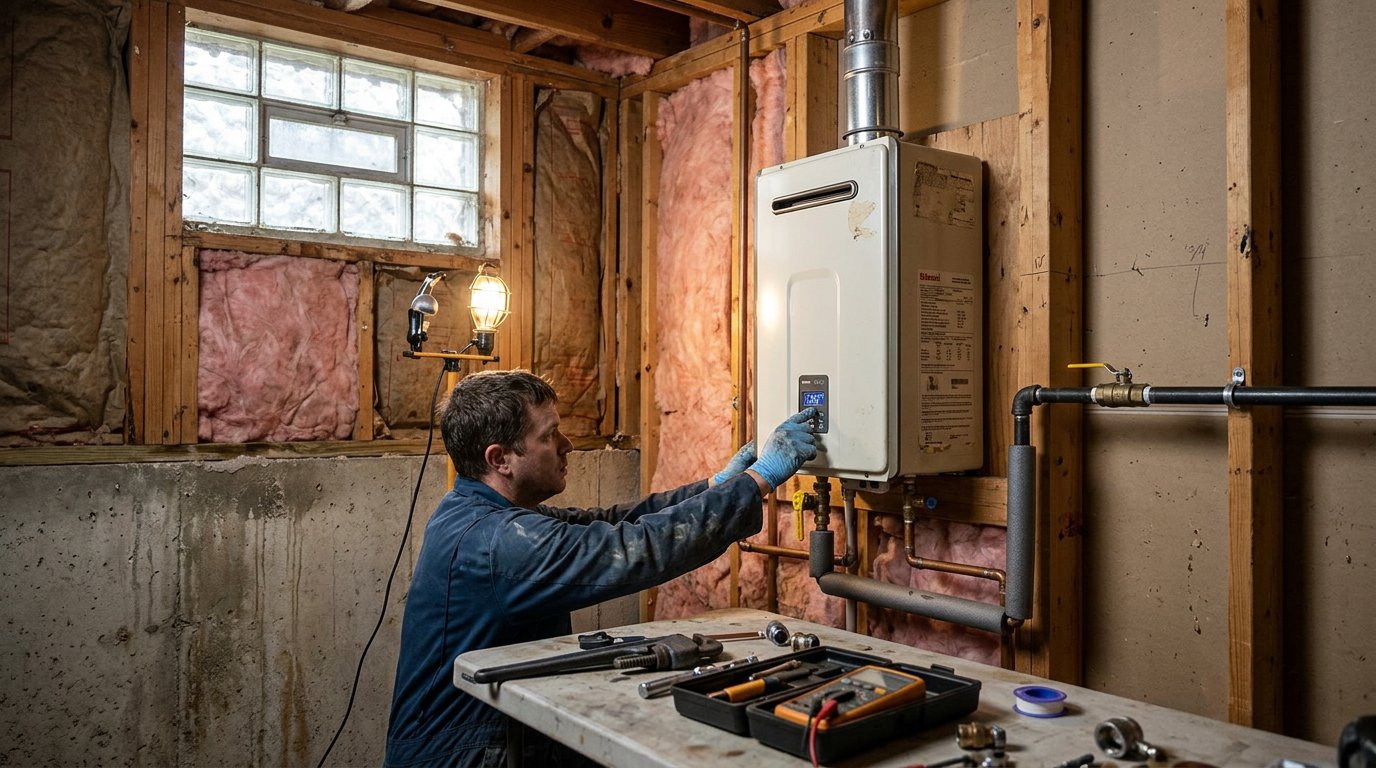
What Size Tankless Water Heater Do You Actually Need in a Knoxville Home?

Most Knoxville homeowners shopping for a tankless water heater pick the wrong size. They pick by the number of bathrooms, or by the size of the gas-tank unit they're replacing, or by whatever the box-store sales tag suggests. None of those methods produces the right answer. The right answer is a number measured in gallons per minute (GPM) at a specific temperature rise, and that number depends on what's happening in your house at peak demand on the coldest morning of the year.
Homeowners who need to install tankless water heaters in Knoxville typically end up at Sanders Plumbing because they've already discovered the box-store rule of thumb doesn't hold up in East Tennessee winters. The rest of this piece walks the actual sizing argument, step by step, in the order a plumber would run it.
Tankless sizing is measured in flow, not gallons
A traditional gas-tank water heater is sized by capacity. Forty gallons. Fifty gallons. The number describes what's stored in the tank.
A tankless heater stores nothing. It heats water on demand as it flows through. The relevant number is the flow rate the unit can heat to a target temperature in real time, expressed as GPM at a given temperature rise. There's no tank, so capacity doesn't enter the calculation.
If you replace a 50-gallon tank with a tankless unit "rated for a 50-gallon tank," you're substituting one specification for an entirely different one. The numbers aren't comparable. A homeowner who buys a tankless unit because the box says "replaces 50-gallon tank" is buying based on marketing copy, not physics.
This first step matters because every later sizing decision flows from the GPM-and-temperature-rise framework. Skip it and the rest of the argument collapses.
Size for peak GPM, not average
A four-person Knoxville household uses roughly 50 to 80 gallons of hot water a day. Average that across a day and the flow rate is trivial. Average it across the morning rush and it's a different number entirely.
Peak demand is what breaks an undersized tankless unit. Two showers running at the same time as a dishwasher draws from the hot line. A washing machine on hot wash cycle while someone shaves at a bathroom sink. The unit has to deliver hot water to all simultaneous fixtures or someone gets cold water mid-shower.
Sizing tankless units off average usage is how homeowners end up with cold-shower complaints six months after install. Average usage doesn't tell you anything about whether the unit can keep up at 7 a.m.
Count fixtures, not bedrooms
The standard fixture flow rates are well documented:
- Standard shower head: 2.0 to 2.5 GPM
- Low-flow shower head: 1.5 to 1.8 GPM
- Bathroom sink: 1.0 to 1.5 GPM
- Kitchen sink: 1.5 to 2.2 GPM
- Dishwasher: 1.0 to 1.5 GPM during fill
- Washing machine: 2.0 to 3.0 GPM during fill
Add up the fixtures running simultaneously at peak. A house with two showers and a kitchen sink running at the same time needs roughly 5.0 to 6.5 GPM of hot water flow. A three-bathroom house with a busy morning routine can hit 7 to 8 GPM during overlap windows.
The "size by bedroom count" rule of thumb isn't useless, but it's a proxy for fixture count, not a replacement. Two-bedroom houses with three full baths exist. Five-bedroom houses with one shower exist. The fixture math is more accurate than the bedroom math, and it's what plumbers actually use when they're not in a hurry.
Knoxville winter inlet temperatures break most online sizing calculators
Here's where the argument gets specific to East Tennessee.
Tankless GPM ratings are published at a "temperature rise," meaning the difference between incoming water temperature and the target output temperature (usually 120°F). A unit rated at 7.5 GPM at a 35°F rise will deliver only about 5.0 GPM at a 60°F rise. The colder the inlet, the lower the effective GPM.
In Knoxville, groundwater temperature drops through winter. Summer inlet runs around 70°F. January inlet drops to 50°F or lower in homes with shallow service lines or above-ground sections. That's a 70°F temperature rise to deliver 120°F shower water in January, versus a 50°F rise in July.
Most online sizing calculators default to a 50°F temperature rise. That's accurate for late spring and early fall, and it's wrong for January. A unit sized for the calculator's default delivers fine in October and falls short on the coldest morning of the year, which is exactly when the household is using the most hot water.
Knoxville-specific sizing has to assume a 70°F rise, not 50°F. That single adjustment is why a "5.0 GPM" unit that worked fine in Atlanta marketing copy may be undersized for an East Tennessee home.
Knoxville hard water cuts tankless capacity over time
Knoxville Utilities Board water tests show moderate hardness, generally 60 to 120 mg/L of dissolved calcium and magnesium. That's not the worst water in the country, but it isn't soft either, and it has a specific consequence for tankless heaters.
Tankless units have a heat exchanger with narrow passages. Hard water deposits scale on those passages. Scale reduces the effective flow rate the unit can heat, because the same heating element now has to push more BTU through a partially restricted heat exchanger.
A tankless unit installed at 8.0 GPM rated capacity in clean conditions can drop to 6.5 to 7.0 GPM effective capacity within 18 to 24 months on Knoxville water without descaling. Sizing has to account for that decline. The right move is either to size up by about 10% to absorb the future capacity loss, or to commit to annual descaling maintenance from day one.
A homeowner who sizes the unit exactly to current peak demand on day one is the homeowner who calls a plumber 18 months later complaining about lukewarm showers. The unit hasn't failed. It's just descaled enough to fall below the demand it was sized for.
The right size is usually bigger than the box store says
Run the prior steps against a typical Knoxville household and the numbers come out roughly:
- Two-bath house, family of four, January peak demand: roughly 5.5 GPM at a 70°F rise
- Three-bath house, family of four to five, January peak: roughly 7.5 GPM at a 70°F rise
- Three-bath house with a soaking tub fill cycle in the mix: 8.0 to 9.0 GPM at a 70°F rise
A 7.5 GPM unit at 70°F rise translates to roughly an 11.0 GPM unit at the manufacturer's published 35°F rise. That's a high-end residential gas tankless, often the largest residential model the brand offers, frequently a 199,000 BTU unit.
The math gets uncomfortable here because it argues for a larger unit than the box-store rule of thumb suggests, and a larger unit costs more upfront. But the alternative is a properly-priced tankless unit that delivers cold showers in January, which is the most common complaint plumbers hear about tankless installs in Knoxville.
When the right size exceeds your gas service
There's a ceiling on residential tankless sizing that homeowners hit if they push it too far.
A 199,000 BTU gas tankless unit needs a 3/4-inch gas line at minimum, and on long runs through a Knoxville crawlspace it may need a 1-inch line. Many older Knoxville homes built before the 1990s have 1/2-inch gas service throughout. Upgrading the gas line for a tankless install can cost $800 to $2,000 depending on the run length, and that cost is invisible in the original tankless quote unless the contractor pulled a load calculation.
Some homes simply can't run the largest residential tankless on existing gas service. The options are:
- Upgrade the gas service (expensive, but permanent)
- Drop down to a smaller tankless and accept some peak-demand limitation
- Consider two smaller tankless units in parallel for high-demand homes
- Stay with a tank water heater if the math doesn't work
A plumber who sizes a tankless unit without checking gas line capacity is selling you the unit and a follow-up bill.
Whole-house electric tankless rarely pencils in Knoxville
Electric tankless gets pitched as the easier install. No gas line, no venting work, plug it in and go. The marketing is true on small point-of-use units. It's misleading on whole-house systems.
A whole-house electric tankless capable of 7 to 8 GPM at a 70°F rise pulls 27 to 36 kilowatts. That's three to four 60-amp 240V circuits, often a 200-amp panel upgrade in older Knoxville homes, and a service drop conversation with KUB if the existing service is 100 amps.
The install cost on a whole-house electric tankless can exceed the install cost of a gas tankless once panel upgrades are factored in, and the operating cost on Knoxville electric rates runs 2.5 to 3 times the operating cost of gas. For a four-person household running peak demand in winter, the electric option pencils to several hundred dollars more per year on the utility bill, plus a much larger upfront install.
Electric whole-house tankless is correct for a specific subset of Knoxville homes: no gas service available, low daily demand, and a panel that's already 200-amp with capacity to spare. Outside that subset, gas tankless is almost always the right call.
What the sizing math actually produces for a Knoxville house
The right tankless water heater for a Knoxville home is the unit that delivers peak GPM at a 70°F temperature rise, with 10% headroom for future scale buildup, on a gas line large enough to feed it.
That's not the number a box-store quick-pick produces, and it's not what a generic online calculator produces either. It's the number that determines whether the install delivers hot showers in January or cold showers in January, which is the only criterion that matters once the unit is in the wall.
The plumbers who install tankless units in Knoxville every week have seen which sizing methods produce happy customers and which produce service callbacks. The methods that produce happy customers are the ones that respect every step of this argument. Skip a step and the conclusion at the end is wrong.
How to walk into a tankless quote conversation
Show up with three numbers in hand:
- Peak simultaneous fixture count for your household's busiest morning
- Knoxville winter inlet temperature assumption (use 50°F for the worst case)
- Existing gas service line size and panel capacity
A plumber who can take those three inputs and walk you through a sized recommendation in under fifteen minutes is the contractor you want. A plumber who quotes you a unit before asking what's running simultaneously at 7 a.m. is selling.
Tankless installs that go well in Knoxville are the ones where the sizing math was done correctly before any pricing was discussed. The ones that produce angry phone calls eight months later are the ones where someone skipped to the price.
If the math is wrong, no amount of clean install work fixes it. The unit either delivers hot water at 7 a.m. on a January morning or it doesn't, and that outcome is decided in the sizing calculation, not at the wrench.
RELATED ARTICLES

Stubborn fat ignores the gym, and that is the whole pitch behind ultrasonic cavitation.

The phrase that ruins this for everybody is "put under." People use it casually, the way you would talk about getting your oil changed, and it plants a picture that has very little to do with what

Modern AI-driven hearing aids treat speech and noise as two separate audio streams.

A 2023 study by the National Association of Realtors found 30% of homebuyers would not buy a house with old plumbing. Yet, only 12% of sellers focus on plumbing upgrades.

According to The Water Heater Warehouse (a special

As a homeowner, you know how important a reliable water heater is. Water heating takes up about 18% of your monthly bills.