What Sedation Dentistry Actually Feels Like

The phrase that ruins this for everybody is "put under." People use it casually, the way you would talk about getting your oil changed, and it plants a picture that has very little to do with what happens in a general dentist's chair.
I went in assuming the choice was about how frightened you are. That is part of it. But most of what steers the decision is what is being done to your mouth, how long you have to hold still for it, and whether you have a way home. Fear is one needle on the compass, not the whole instrument.
So I stopped reading and started calling, and Hillsboro Dental Excellence (one of the dentists near me who took the question seriously) walked me through what the two common options actually do to a person, beginning with the fact that neither of them puts you to sleep.
That was news to me. I suspect it is news to a lot of people who have been quietly not booking anything.
Two options that sound similar and are not
Most general practices keep two things on hand. Nitrous oxide, which everybody calls laughing gas, and oral conscious sedation, which comes as a pill you take before the appointment. People talk about them as though they sit on the same dial at different settings. They do not. They are closer to two different tools that happen to solve overlapping problems, and choosing between them has less to do with your nerve than with the job in front of you.
The gas barely counts as an event
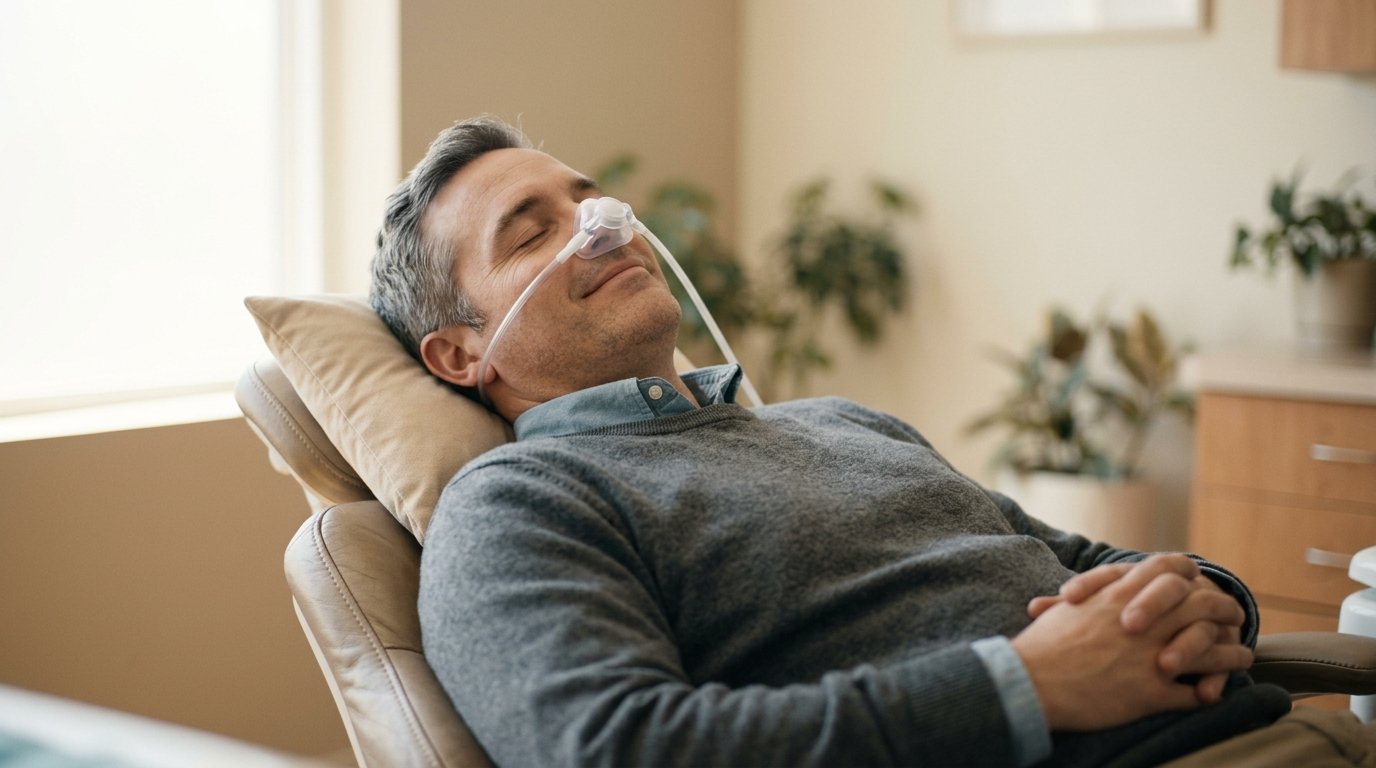
Nitrous comes through a small mask that sits over your nose, and you breathe normally through it. It starts working almost immediately. The word people reach for most often is floating, a kind of pleasant distance from the whole business of having somebody work in your mouth. The room does not go away, it just stops mattering.
You are awake for all of it, you can talk, and you know exactly where you are.
When the work is done the mask comes off and the gas clears about as fast as it arrived, which is the part that surprises people. You drive yourself home. Nothing about the rest of your schedule has to change, assuming the procedure was not a big one. It is mild enough that it gets used routinely with children, which tells you most of what you need to know.
The pill is a heavier thing
Oral conscious sedation is what offices reach for when the work is longer or more involved, a crown and a couple of fillings in one sitting rather than a quick look. It is a medication you take beforehand, and it does not feel like a bigger dose of the gas. It makes you drowsy and unhurried, oddly indifferent to how long the appointment is taking.
You are still conscious, still able to answer a question and follow an instruction.
But it does not switch off cleanly the way nitrous does. Somebody you trust has to drive you home, and you stay out of the driver's seat afterward until it has fully worn off. That is the real trade. The gas costs you nothing on the way out, and the pill costs you a ride home.
What the word conscious is doing in there
Both of these are conscious sedation, and that word is not decoration. It is the entire category. Being put under, in the way people mean it when they say it, is general anesthesia. That belongs to hospitals and oral surgeons and a different level of monitoring. It is not what is happening when a general dentist relaxes somebody for a crown.
They want you awake on purpose
This is the part I had backwards. I assumed a dental team would prefer an unconscious patient, because an unconscious patient does not squirm or complain or ask what that noise was. Turns out that is not how they think about it at all.
A responsive patient is the best monitor in the room. You can say the words "I can still feel that" and change what happens next. You can wince, lift a finger, answer a question, tell somebody something is wrong long before any machine would. Sedation that keeps you alert enough to do that is safer than sedation that takes you out of the conversation, and it is built that way on purpose.
Sedation and numbing are not the same job
Here is the misunderstanding that causes the most damage.
Sedation handles your nerves. Local anesthetic handles the pain. They are two different medications doing two different jobs, and they get used together, which means that if you expect the gas to make a procedure painless all by itself, you will be let down by the wrong thing. People who have had a rough appointment sometimes decide that sedation does not work on them. Often what did not work was the numbing, and that is a separate conversation with a separate fix.
Not remembering is not the same as not being there
A fair number of people come out of oral sedation with a patchy memory of the appointment, or almost none of it. Most of them count that as a win, and I do not blame them. If the hour you were dreading leaves no footage behind, the dread has nothing to feed on the next time.
It is worth being precise about it, though. That is a hazy memory, not unconsciousness. You were present the whole time. You were talking, you were responding, and your brain simply declined to file the paperwork.
Who each one is actually for
The pattern I kept hearing sounds like this. If the appointment is short and straightforward and you are merely tense about it, the gas is usually enough, and it costs you almost nothing on the way out the door. That covers a lot of ordinary dentistry, more of it than most nervous people assume.
If the appointment runs long, or several things are being handled at once, or the thought of the chair produces genuine dread rather than ordinary nerves, the pill is what comes up.
And if you have a real phobia, or a history of never quite getting numb, or a medical picture that complicates everything, it stops being a menu question. That is a conversation, not a checkbox on an intake form. It might even end somewhere other than a general practice, and an office willing to say so out loud is doing you a favor.
The side effects are small, which is not the same as none
Both are considered to have few side effects. Mild nausea shows up occasionally. Hiccups, oddly, show up too. Nothing you inhale or swallow is entirely free of risk, though, and any office that tells you otherwise is selling rather than explaining. Which is why the boring questions turn out to be the good ones.
What I would want settled before I said yes
The useful questions turned out to be plain ones. Which of the two am I getting, and why that one for this particular job. Am I driving myself home or finding a ride. What happens if I am still feeling things once you have started. And who in the building is certified to give it.
None of it requires understanding pharmacology, only an office willing to answer in normal words. I came into this expecting to be talked out of a fear. What I got instead was a smaller and more usable idea, which is that the fear was never really the variable. The appointment is. Match the sedation to the work, stay awake enough to speak up, and the thing shrinks down to something fairly ordinary.
RELATED ARTICLES

Stubborn fat ignores the gym, and that is the whole pitch behind ultrasonic cavitation.

Modern AI-driven hearing aids treat speech and noise as two separate audio streams.
Most Knoxville homeowners shopping for a tankless water heater pick the wrong size.

A 2023 study by the National Association of Realtors found 30% of homebuyers would not buy a house with old plumbing. Yet, only 12% of sellers focus on plumbing upgrades.

According to The Water Heater Warehouse (a special

As a homeowner, you know how important a reliable water heater is. Water heating takes up about 18% of your monthly bills.